

In the summer of 1996, I thought I was ahead of the curve.
I was college-bound and landed an internship at IBM’s headquarters in Paris. Other than earning my first paycheck ever, what excited me most was the opportunity to be immersed in the tech world on the eve of the dot-com boom.
It was picks and shovels time. At my desk, I had a Pentium Pro running OS/2, a 17-inch SVGA CRT for building slideshows in Freelance Graphics, and a copy of Ed Tittel’s HTML for Dummies to teach myself to build websites in my spare time. At meetings, IBM execs took notes on sleek ThinkPad laptops with butterfly keyboards. CEO Lou Gertsner himself paid us a visit on campus to extol the virtues of our new mainframe lineup and how they would power the upcoming Olympic Games in Atlanta. I nodded knowingly. The team I supported was responsible for driving our top EMEA customers to attend, and I must have stuffed hundreds of AS/400-branded keychains, along with other themed tchotchkes, into goodie bags meant to sway them.
I was in the zone: learning from the best, at one of the world’s most prestigious companies, and already thinking about how I’d apply these skills in college to keep my streak of teenage Indian overachievement going 😉.
Poster boy
Then I started hearing about this other “boy”, Sabeer Bhatia.
Not from the news. Not from the internet — it was still too early for that. But through the way you heard everything in a South Asian household in the 1990s: the aunties. Overheard phone calls. Dinner party conversations. My mother’s voice, rising over the din, exclaiming with the same blend of awe and competitive appraisal whenever she brought up the topic: “Can you imagine? Indian boy… only twenty-seven years old. He goes to Stanford, studies engineering, and then builds this computer thing, and now everyone is talking about it!”
That computer thing? That was Hotmail, one of the world’s first free browser-based email services. Within weeks of its launch, it went viral, spreading online just as quickly as the news of the Indian boy who built something from nothing spread through the global auntie network.
What none of the aunties fully appreciated — what almost nobody outside of Silicon Valley understood at the time — was that Bhatia hadn’t just built a killer service. He’d invented an entirely new way of marketing one. And three decades later, every product that grows by attaching its name to your workflow is still running his play.
Before Hotmail, Email Was a Walled Garden
In 1996, only about 20 million American adults had access to the internet at all — roughly the same population as Florida. Netscape Navigator, then commanding nearly 80% of the browser market, had only gone public the year before. The web was still a novelty. Most households weren’t on it. And if you were on it, having an email address wasn’t something that traveled with you.
Yes, email existed, but it was tethered. You had an address through your employer, your university, or your ISP, and the moment you left any of those, that address went with it.
Accessing email required a dedicated desktop client. Eudora, the most popular of its era, had a devoted following among power users, but cost up to $65 for the full version and required configuration on a specific server on a specific machine. Microsoft’s Outlook and Lotus Notes were enterprise products bundled into their respective suite.
Bhatia met co-founder Jack Smith while working at Firepower Systems, after an earlier stint at Apple. They had initially planned to build a web-based database where you could store anything — files, pictures, documents — and retrieve it from anywhere. The pivot to Hotmail was almost accidental and came from hitting a mundane wall at their day jobs. Corporate firewalls were blocking their personal email accounts.
“That’s when the idea of making email available on the web came to us. It was as simple as that. We said, wow, we could access our email from anywhere in the world. That was the genesis of Hotmail. And that’s why it’s called Hotmail — HTML mail.”
No configuration. No ISP tie-in. No desk. No institution. Just a username, a password, and a 2MB inbox waiting for you from any connected computer on earth.
They launched on July 4, 1996. Independence Day. A choice that was equal parts symbolic and on-the-nose. Freedom from ISP-bound email. With $300,000 in seed funding from Draper Fisher Jurvetson, two founders, and a prayer, Hotmail opened its doors to the public.
“Just Put It on Every Email”
For the first few months, growth was real but measured. Bhatia was thinking of billboards, radio spots, aka the standard playbook for getting the word out. Then Tim Draper — DFJ’s founder — sat down with the team and asked the question that changed everything.
“Can’t you just give it out to all those guys on the web?”
“That would be spamming”, Smith replied.
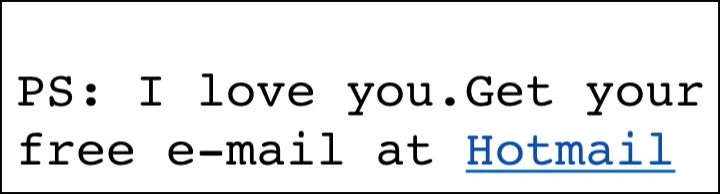
Draper, who’d never heard the term before, thought for a moment, then landed somewhere else. He’d recalled a Harvard Business School case study about women holding Tupperware parties — selling to friends, who then sold to their own friends. What if every Hotmail user’s outgoing email became a silent referral by embedding a simple tagline in the footer? He originally suggested “P.S. I love you. Get your free email at Hotmail.” The team resisted at first, but eventually settled for something simpler: “Get your free email at Hotmail.com.”
Six words. No advertising budget. And within hours of flipping the switch, the growth went up and to the right.
Bhatia had built the virus before anyone named the disease.
Making aunties proud
Within six months, Hotmail had 1 million users. Five weeks after that, 2 million. At its peak, the service was adding 60,000 new accounts every single day — on an internet that still only had tens of millions of users worldwide.
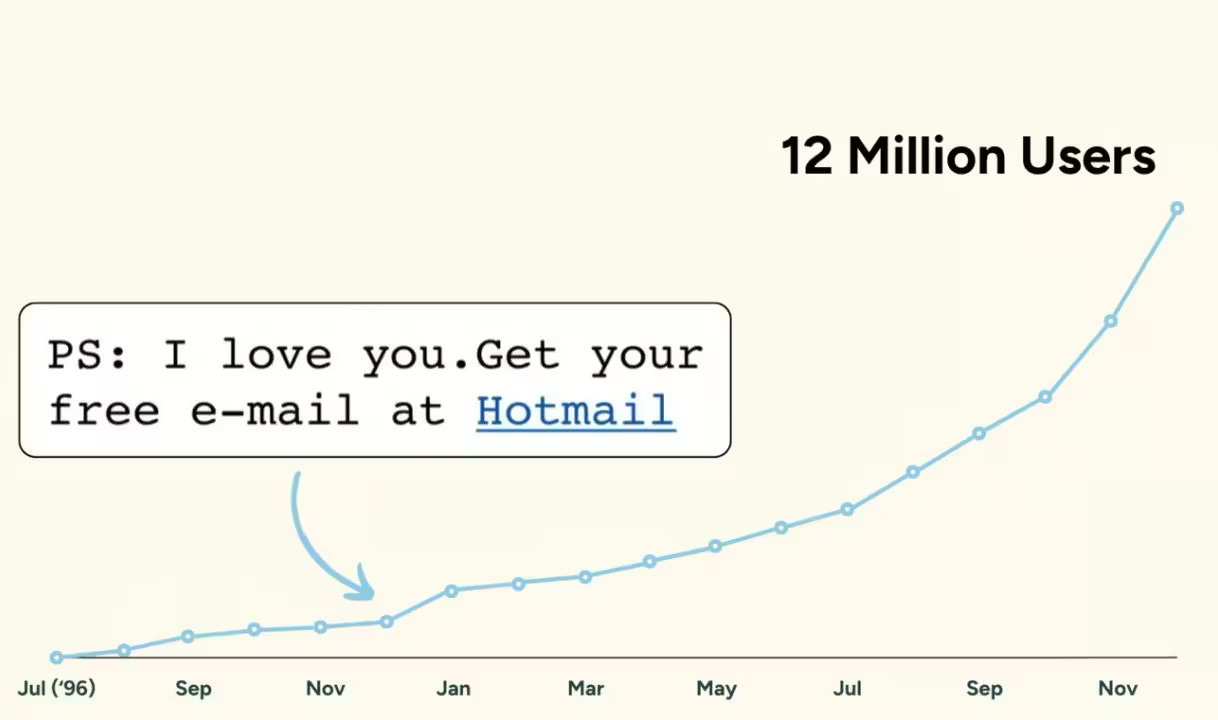
By December 1997, just eighteen months after launch, Hotmail had 8.5 million active accounts (some sources say up to 12 million by early 1998). That made it one of the largest services on the entire internet at the time. That’s also when Microsoft came in and acquired the company for $400 million in stock, making it the largest internet startup deal of its time.
The mechanic itself was dead simple: every email sent through Hotmail was simultaneously an advertisement for the service. You didn’t need to convince anyone to try it. They just had to receive an email from you, someone they trust. This made every user, whether they realized it or not, into a salesperson. Every inbox message composed in Hotmail was an invitation to try the product for free.
It was one of the world’s first examples of viral marketing, but nobody was calling it that yet. The term, borrowed from epidemiology, would come later. But Bhatia had built the virus before anyone named the disease.
Most Remarketable: The Growth Loop That Keeps On Giving
Before Hotmail launched in 1996, social proof meant a logo wall, an endorsement, a case study, a press release. After Hotmail, it could be as simple as six words at the bottom of a colleague’s email or four words attached to a meeting invite. Bhatia and the Hotmail team showed that social proof could be ambient — not a marketing asset you produced, but a byproduct of the product experience itself.
The lineage is direct and traceable. Research in Motion, the company behind BlackBerry, baked “Sent from my BlackBerry” into its default email signature, and enterprise executives happily kept it as a badge of honor. Apple followed with “Sent from my iPhone,” which became arguably the most-read four words in the history of mobile.
When I led ISV Marketing at Salesforce, we built a similar loop into Chatter, the CRM’s built-in social feed, to evangelize partner wins. Every time a partner-sourced deal closed, the rep who owned the account got a public @mention notifying them of the quota relief they received courtesy of that partner. And because account executives followed one another, it spread across the sales org within weeks. The inspo was Bhatia’s logic, even if none of us called it that.
Fast-forward to today and Calendly appends “Scheduling powered by Calendly” to every meeting invite its users send. Notion drops its watermark on every shared page.
But the pattern is always the same: discreetly plug the product at the moment of use, and let network effects do the rest.
Least Remarketable: When the badge does not belong
But here’s the insight that separates the products that ran Bhatia’s play successfully from the dozens that tried to copy the mechanic without copying the logic: the tagline only lands if it’s native to the workflow, not tacked onto it.
Hotmail’s footer worked because it was organic. It lived inside the email itself — the very thing people were already paying attention to. It didn’t redirect you. It didn’t ask for your time. It arrived in context, carried by trust, and cost nothing to deliver. The same is true for “Sent from my Blackberry.” You didn’t see it on a billboard. You saw it at the bottom of a message from your boss, your co-worker, or your client. Calendly’s link appears in the meeting invite you were going to send anyway. In each case, the tagline is native to the action. It doesn’t interrupt it. It doesn’t redirect from it. It just flows.
Contrast that with some of the recent viral mechanics that feel bolted on. “Powered by Shopify” at the bottom of an e-commerce storefront — one of the most Googled phrases in web design is how to remove it. “Made with Lovable” — same story. When the badge feels like free advertising foisted on users rather than a natural artifact of their activity, the user’s first instinct isn’t to share it — it’s to figure out how to get rid of it, with some even willing to pay for removing the badge.
P.S. I love you
Does your product carry your message when it travels?
Not your ad. Not your landing page. The product itself.
When someone uses your tool, shares their work, or sends something through your platform, does that act make your next potential customer curious about your product? Does it make them want in?
Right now, AI startups are locked in a specs war — benchmarks, token counts, context windows — while users hop between models because they all feel interchangeable.
Hotmail made its inroads with none of that. No feature comparison. No benchmark bragging. Just six words at the bottom of something people were already sending and finding useful, promising you the same experience.
Draper’s original line — “P.S. I love you” — never made it onto the product. But in a way, it’s exactly what millions of people were saying, without realizing it, every time they hit send.